
Siemens' SINAMICS G drive line-up, from the programmer's side
Five variable frequency drives, one family: the G200, G210C, G210, G210X and G220. Here is what each one is for, how they compare on Siemens' own product pages, and what the manuals say about the things a programmer meets first: ports, telegrams, the web server, safety and security.

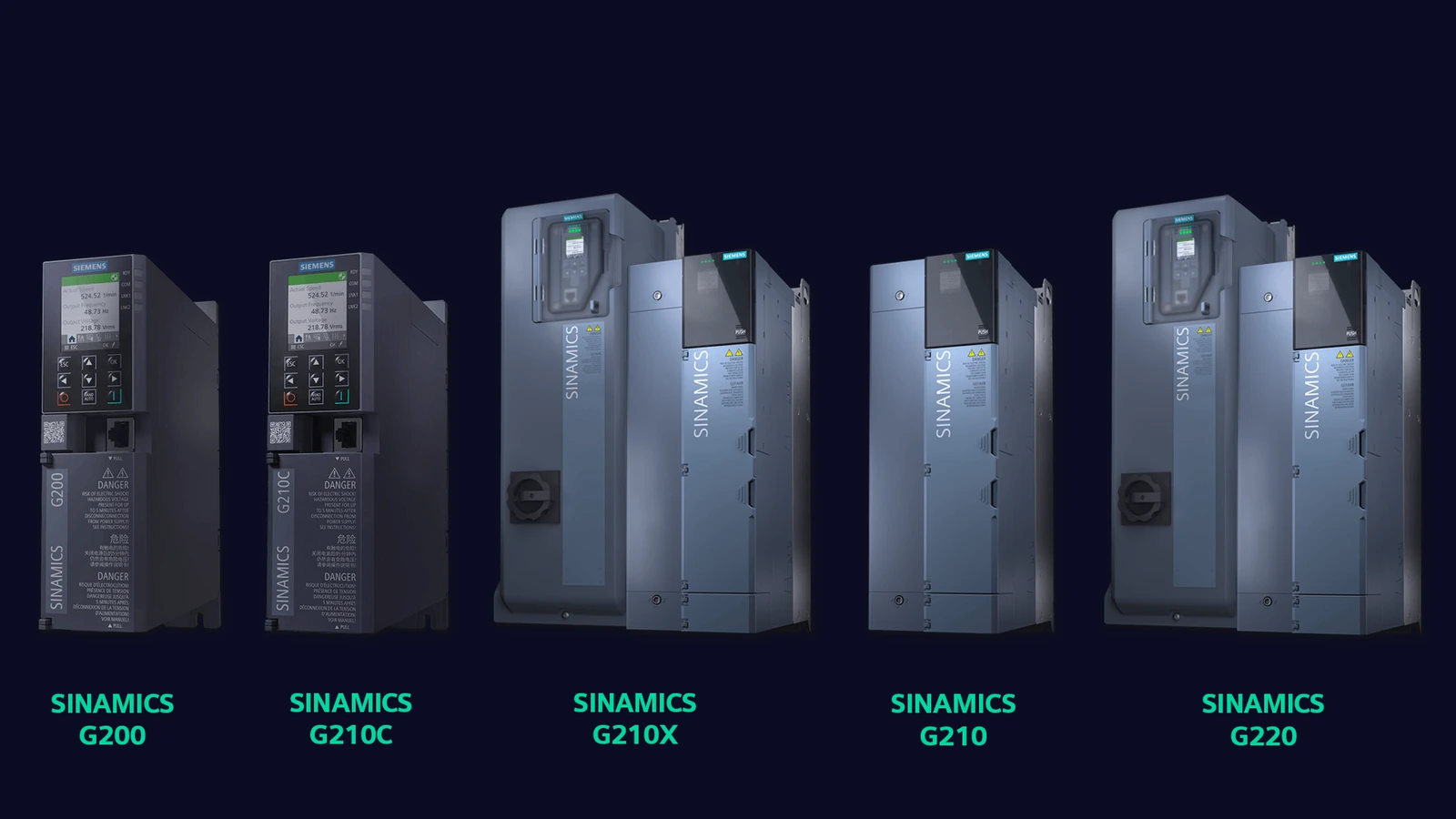
Siemens now presents its next generation of SINAMICS G drives as one family of variable frequency drives: the G200, G210C, G210 and G210X, together with the G220 that came first, in 2023. A press release of 28 October 2026 puts the five under one banner. Each of them already has its own product page, and the G200 has its manuals online.
This article goes through the line-up one drive at a time, with Siemens' own pictures, and then reads it the way the person who commissions the drive and writes the PLC code reads it. Which telegrams does it speak? What IP address does it come with? How do you get into it without a laptop full of tools? What will the safety wizard do to a machine that is half commissioned?
The line-up in short
The picture at the top is Siemens' own family picture of the five drives. They differ in size and in the jobs they are meant for, but Siemens describes them as one portfolio for continuous-motion applications, on a common technology platform, with one way to engineer them and one way to operate them.
In short: two compact IP20 drives for machines (the G200 and the G210C), an all-rounder (the G210), a specialist for pumps, fans and compressors (the G210X), and the high-performance G220 from 2023. The sections below follow Siemens' order, with the G220 last.
SINAMICS G200
Standard applications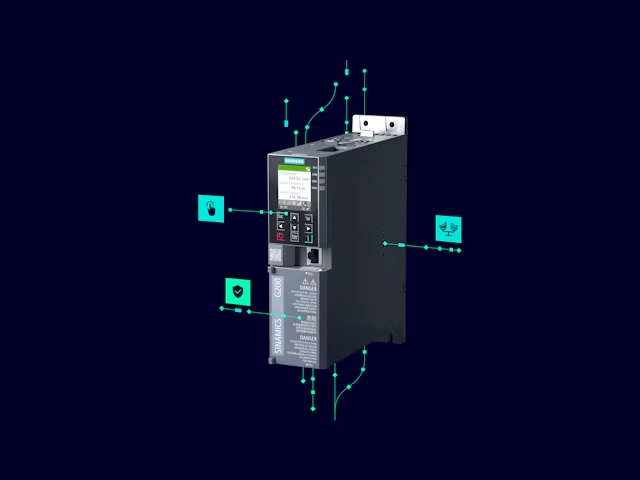
Siemens introduces the G200 as a new member of the next-generation SINAMICS family, for standard industrial applications such as pumps, fans and conveyors. It covers 0.55 to 11 kW at 3 AC 380–480 V and 0.55 to 4 kW at 200–240 V, in IP20. Siemens quotes a width from 50 mm, and drives can be mounted side by side with 3 mm between them.
An EMC filter and a braking chopper are on board, and the page lists 3C2 coating, C3 EMC behaviour and an independent air duct. Control modes are U/f, flux current control (FCC), ECO and speed vector control without an encoder, for induction, permanent-magnet and synchronous reluctance motors, with an ECO mode that adjusts voltage and flux to the load. The network is PROFINET (the page text also mentions EtherNet/IP). STO and SS1-t are integrated, wired through terminals, with SIL 3, PL e and Category 4.
For commissioning Siemens names the built-in web server, the SDI Lite and SDI Pro operator panels, the Smart Adapter for Wi-Fi, and Startdrive in the TIA Portal. It is also the drive whose manuals this article could read in full, which is why the programmer's sections further down are based on it.
- 0.55–11 kW
- IP20
- From 50 mm wide
- PROFINET
- STO, SS1-t built in
Siemens namesconsumer packaged goods, intralogistics, general machinery
SINAMICS G210C
Compact machines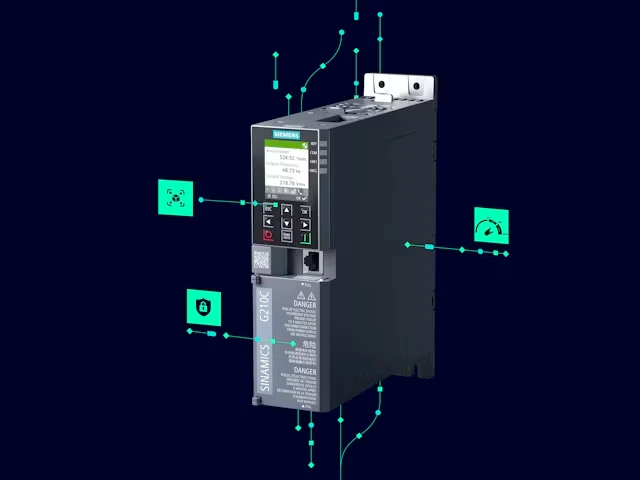
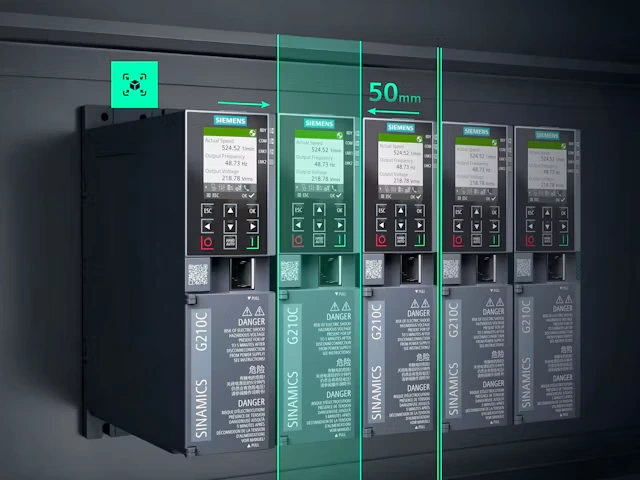
The G210C is the compact one, aimed by Siemens at OEMs that need more than a standard drive. Frame sizes start at 50 × 171 × 170 mm, drives can be mounted side by side with 3 mm between them, and the range is 0.55 to 7.5 kW at 3 AC 380–480 V and 0.37 to 4 kW at 200–240 V, in IP20 or UL Open Type.
According to Siemens' FAQ, what sets it apart from the G200 is integrated PROFIsafe, up to 200 % overload capability and EMC class C2. The page gives the overload as 200 % for 3 seconds and 150 % for 57 seconds. The G210C tops out at 7.5 kW, below the G200's 11 kW, so the difference is overload headroom and safety, not size. Safety Integrated covers STO and SS1-t up to SIL 3, PL e, Category 4, with optional encoderless safety functions.
The same FAQ says the G210C keeps the capabilities of the G120C and adds enhanced motor control, more safety functions, web-based commissioning and a more robust design. Communication is PROFINET with PROFIsafe and PROFIenergy. Engineering is the TIA Portal with an integrated web server and wireless access, and the page names UMAC user management and IEC 62443-4-2 Security Level 2.
- 0.37–7.5 kW
- IP20 / UL Open Type
- Up to 200 % overload
- PROFIsafe
- EMC class C2
Siemens namesconsumer packaged goods (conveyors, mixers, pumps, fans), intralogistics, general machinery
SINAMICS G210
The all-rounder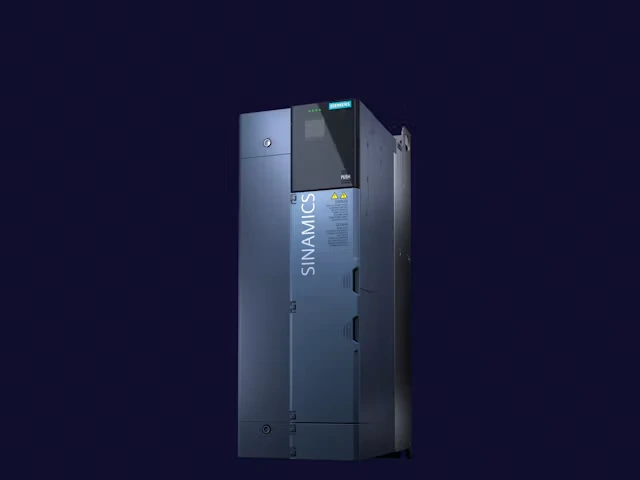
The G210 is Siemens' versatile all-rounder for continuous motion: moving and positioning, processing tasks and compressing. It is the largest of the four new drives, 1.1 to 75 kW at 3 AC 380–500 V, in IP20 or UL Open Type. Siemens stresses motor openness and modular hardware and software, so that one drive series can serve different machines.
The data shows it. Control modes run from U/f and flux current control to vector control of speed and of torque, plus torque control, each with or without an encoder, for induction, synchronous reluctance and permanent-magnet motors, third-party motors included. One encoder can be added through an option module (OM DQ for DRIVE-CLiQ encoders, OM ENC for HTL, TTL and SSI), and Siemens says encoderless closed-loop vector control works from zero speed, by pulse injection, on motors with a reluctance torque component. Communication comes as a module: CM-PN for PROFINET (RT, MRP and S2 redundancy), Modbus TCP/IP and EtherNet/IP, CM-DP for PROFIBUS DP, or CM-RS485 for Modbus RTU.
Safety is STO and SS1-t up to SIL 3, PL e, Category 4, through terminals or PROFIsafe, and an extended licence adds SLS, SDI, SSM and encoderless SS1. The page also lists integration with SIMATIC PCS 7 and PDM through an FDI package, and Wi-Fi access through the Smart Adapter.
- 1.1–75 kW
- IP20 / UL Open Type
- Vector control with or without encoder
- Fieldbus by module
- PROFIsafe or terminals
Siemens namesgeneral machinery (from conveyors and compressors to mixers and centrifuges), consumer packaged goods and life sciences, tire industry
SINAMICS G210X
Pumps, fans, compressors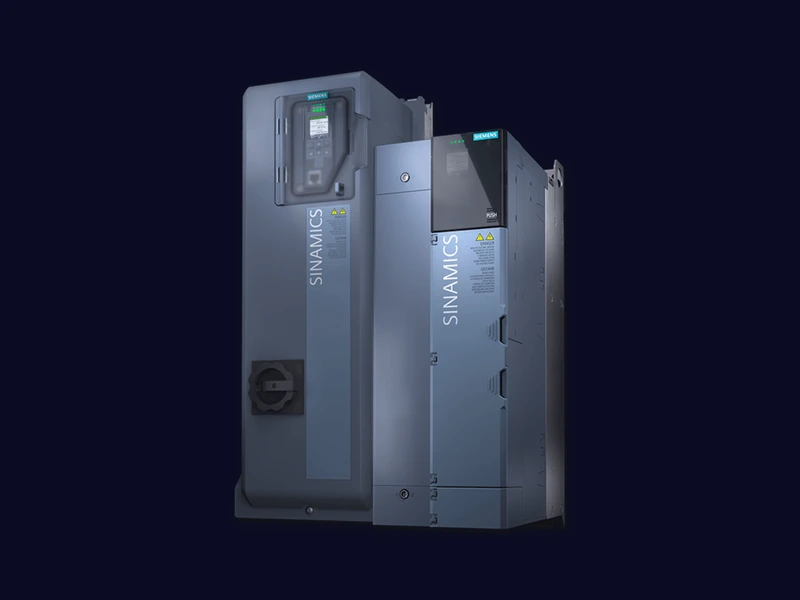
The G210X is the member for pump, fan and compressor applications: water and wastewater, HVAC and other infrastructure. It covers 1.1 to 55 kW (1.5 to 75 hp) at 3 AC 380–500 V in two variants, IP20 and IP55. The ambient range is −20 to 60 °C for IP20 and −20 to 50 °C for IP55, with derating above 45 and 40 °C. The page lists an integrated EMC filter and DC link choke, 3C3 coating, and STO and SS1.
The application functions are the point: PID control, de-ragging, pipe filling mode and an ECO mode, with support for IE4 and IE5 motors (induction, synchronous reluctance and permanent magnet). Control is V/f or flux current control. The G210X can take part in PROFINET S2 redundancy, and its interfaces are PROFINET RT, EtherNet/IP, Modbus RTU and TCP, PROFIBUS DP and OPC UA. It is the only one of the five whose page names OPC UA.
Pump control is not exclusive to the G210X: the G200 manual has a pump control chapter too, with frost protection and condensation protection, and a technology controller. For the programmer the question is where a control loop lives. A loop inside the drive does not depend on the PLC cycle, while a loop in the PLC keeps all the logic in one place. Both are possible, and which is better depends on the plant.
- 1.1–55 kW
- IP20 or IP55
- PID, de-ragging, pipe filling
- OPC UA
- S2 redundancy
Siemens nameswater, HVAC (irrigation, water and wastewater treatment, desalination)
SINAMICS G220
Since 2023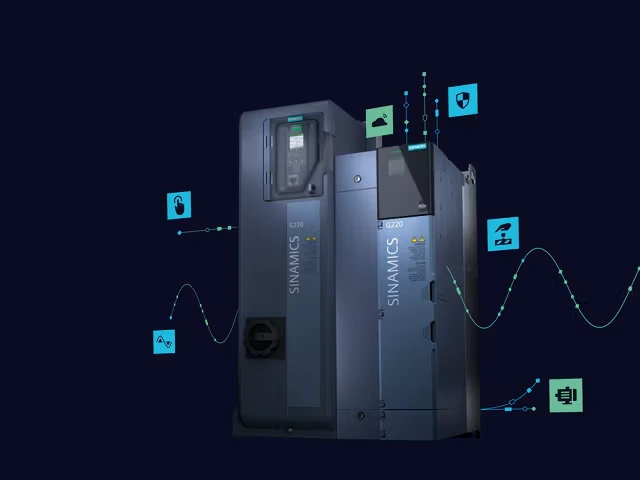
The G220 came first. Siemens introduced it in 2023 and describes it as a high-performance variable frequency drive for all industries. Its product page calls it the first SINAMICS drive to join the Siemens Xcelerator portfolio. It has the widest range: 0.55 to 55 kW at 3 AC 200–240 V and 1.1 to 160 kW at 3 AC 380–500 V, in IP20 or IP55 / UL Type 12 up to 110 kW. A Clean Power version, 7.5 to 160 kW, aims at low harmonics: a total harmonic current distortion (THDi) below 2 %.
On the pages it is also the most fully equipped. Siemens lists PROFINET with RT and IRT, MRP, MRPD and S2 redundancy through a communication module, two encoder connections (OM-DQ takes two DRIVE-CLiQ encoders, OM-ENC takes one HTL, TTL or SSI encoder), vector and torque control with and without an encoder, and drive-based positioning with the integrated Basic Positioner (EPOS), with Positioning Extended and Positioning Advanced as software options. The extended safety licence lists nine functions: SS1, SS1E, SS2, SS2E, SLS, SLA, SSM, SDI and SOS.
On the engineering side Siemens highlights selection tools (a SINAMICS Selector for the smartphone, the Product Configurator and the TIA Selection Tool) and a digital twin: DriveSim Engineer, integrated in Startdrive, lets the drive's behaviour be tested without hardware. Among the customer examples on the page is a wastewater pumping station in Oyten, Germany, where Siemens says harmonics fell below 2 % and the control cabinet shrank by 30 %.
- 0.55–160 kW
- IP20 or IP55
- Clean Power option
- PROFINET RT/IRT
- Two encoders
Siemens namesmoving, processing, pumping, ventilation and compressing, positioning; food and beverage, life sciences and chemicals, energy and marine
Siemens' three headline benefits
Siemens sums up the G220 in three words, each with an icon of its own on the product page: efficient, secure and future-proof.

Clean Power technology for low harmonics (THDi below 2 %), and shorter selection and commissioning times.

S2 system redundancy, IP55 protection and 3C3 coating, for availability even in harsh environments.

Cloud and edge monitoring and diagnostics, with hardware and software options for changing market needs.
The three benefits are Siemens' own summary of the G220. Image: Siemens.
What the five have in common
The release (Siemens press release, 28 October 2026) is short, and it has no power ranges and no dates. The substance, in Siemens' order:
- Three principles. Security by Design, integrated safety functions, and digitalization for more transparency and smarter maintenance management.
- Cybersecurity. All drives of the new generation will be made ready for the EU Cyber Resilience Act (CRA) and will offer integrated security capabilities up to Security Level Capability 2 (SL-C 2) under IEC 62443-4-2.
- Safety. Integrated safety functions up to SIL 3.
- Engineering. Integration into the TIA Portal, an integrated web server, and one concept for selection, engineering, commissioning, diagnostics and service.
- Data. OPC UA over Ethernet for drive and operating data, for asset and energy management, condition monitoring and predictive maintenance.
Two phrases deserve a second look. "Will be made" CRA-ready is a promise about the future, and "up to" SL-C 2 is a ceiling that each drive may or may not reach. The release also doesn't say which drive offers which feature. That is what the product pages and the manuals are for, and the rest of this article follows them.
On timing, the release names no date, but the drives are already visible. Each of the five has a product page with a Request quote button, and on 30 October 2026 the pages for the G200, G210, G210X and G220 on Siemens' US site also had Select & order. The G210C page offered only Request quote. The G200 operating instructions are dated 06/2026, and Siemens' download entry for Startdrive V21 Update 1 is from 15 July 2026. A Siemens release republished by Processing magazine on 14 October says the G200 and G210 were to be shown at PACK EXPO International 2026 in Chicago, and Drives & Controls says the family debuts at the SPS show in Germany in November.
Side by side: what the product pages list
The release has no numbers, but the product pages do. This is what each page lists (read on 30 October 2026). "Not listed" means the page doesn't mention it, which is not the same as "not available".
Swipe the table sideways to see all five drives.
| G200 | G210C | G210 | G210X | G220 | |
|---|---|---|---|---|---|
| Power and voltage | 0.55–4 kW at 3 AC 200–240 V; 0.55–11 kW at 3 AC 380–480 V | 0.37–4 kW at 3 AC 200–240 V; 0.55–7.5 kW at 3 AC 380–480 V | 1.1–75 kW at 3 AC 380–500 V | 1.1–55 kW at 3 AC 380–500 V | 0.55–55 kW at 3 AC 200–240 V; 1.1–160 kW at 3 AC 380–500 V (Clean Power: 7.5–160 kW) |
| Protection | IP20 | IP20 / UL Open Type | IP20 / UL Open Type | IP20 and IP55 variants | IP20; IP55 / UL Type 12 up to 110 kW |
| Motor control | U/f, FCC, ECO, speed vector control without encoder | Not listed | U/f, FCC, vector control (speed and torque) and torque control, each with or without encoder | V/f, FCC | U/f, FCC, ECO, vector control (speed and torque) with or without encoder, torque control without encoder |
| Encoder inputs | Not listed | Not listed | One, by option module (DRIVE-CLiQ, or HTL, TTL, SSI) | Not listed | Two (OM-DQ: two DRIVE-CLiQ encoders; OM-ENC: one HTL, TTL or SSI) |
| Network and fieldbus | PROFINET (EtherNet/IP is named in the page text) | PROFINET, with PROFIsafe and PROFIenergy | By module: CM-PN (PROFINET RT, MRP, S2; Modbus TCP/IP; EtherNet/IP), CM-DP (PROFIBUS DP), CM-RS485 (Modbus RTU) | PROFINET RT, EtherNet/IP, Modbus RTU/TCP, PROFIBUS DP, OPC UA | By module: CM-PN (PROFINET RT/IRT, MRP, MRPD, S2; Modbus TCP/IP; EtherNet/IP), CM-DP, CM-RS485 |
| STO and SS1-t | Via terminals; SIL 3, PL e, Cat. 4 | Up to SIL 3, PL e, Cat. 4; PROFIsafe listed | Via terminals or PROFIsafe; SIL 3, PL e, Cat. 4 | STO and SS1 listed; levels not given on the page | Via terminals or PROFIsafe; SIL 3, PL e, Cat. 4 |
| Extended safety (licence) | Not listed | Safety Integrated Extended, with optional encoderless functions | SLS, SDI, SSM, SS1 (encoderless) | Not listed | SS1, SS1E, SS2, SS2E, SLS, SLA, SSM, SDI, SOS |
| OPC UA named | No | No | No | Yes | No |
| What the page stresses | Ease of use, ECO mode, 50 mm width | Compact, up to 200 % overload, PROFIsafe, EMC class C2 | Motor openness, modular hardware and software | Pump and fan functions: PID, de-ragging, pipe filling | Clean Power (THDi below 2 %), digital twin, selection tools |
Table: Siemens' product pages for the G200, G210C, G210, G210X and G220, shortened. The yellow row is the built-in safety. Safety levels are Siemens' own figures for the functions named.
TIA Portal and the web server
Startdrive in the TIA Portal
The drives are engineered in the TIA Portal with SINAMICS Startdrive. Siemens' download page lists Startdrive V21 Update 1 (V21.00.01.00) as the current version, in an entry dated 15 July 2026, and says Startdrive V21 needs STEP 7 V21 installed first. An independent blog that summarises the Update 1 release notes (21 August 2026) says this is the update that adds the G200, G210, G210C and G210X, all from drive firmware V6.7. The G200 manuals are written for V6.7 too. Treat the blog as a pointer, and check Siemens' Compatibility Tool before planning a project on an older TIA Portal. Drives & Controls adds that Siemens plans to launch TIA Portal V21.1 at SPS, so the version to plan around may move.
The same summary mentions four smaller items: a virtual motor encoder for encoderless positioning on the G220 and G210, OPC UA alarms and conditions from firmware 6.7 (marked exploratory, because of known limitations), importing drive backup files straight into Startdrive, which needs the Startdrive Advanced licence, and masks for the G210X's infrastructure functions.
Or no TIA Portal at all
You don't have to open Startdrive to get a drive running. The G200 has a web server built in. You reach it with a browser from a PC, or from a tablet or phone through the optional Smart Adapter (Wi-Fi), or from the SDI Pro 5.5" panel or a SIMATIC HMI such as a Unified Comfort Panel. The G200 compact operating instructions list these pages: quick setup, advanced setup, a Safety Integrated wizard, drive status, inputs and outputs, manual operation, a diagnostics buffer, the parameter list with signal interconnections, backup and restore, firmware update, licences and user management.
The diagnostics menu also lists a page for the control word and status word, and a trace. Those are good first pages to open when a PLC-to-drive link misbehaves. The signal interconnection page shows the BICO wiring, so you can see which parameter each telegram word is connected to.
Logic inside the drive
Drive Control Chart (DCC) is an optional TIA Portal extension for building closed-loop control, arithmetic and logic blocks graphically. According to the G200 operating instructions, the result is transferred to the drive through Startdrive and extends the drive's firmware with those functions. The G200 and G210C pages both name DCC, and DCC V21 is a separate download on Siemens' site. If part of the control belongs in the drive, this is where it goes. The usual caution applies: logic inside a drive is invisible to anyone who reads only the PLC program.
Ports, IP addresses and telegrams
Everything in this section comes from the G200 manuals. The platform is shared, but the manual of the model you are buying is the one to trust.
Two network connections
The G200 has two Ethernet connections with different jobs. The PROFINET interface X150, with two ports, goes to the PLC. The service interface X127 is for the laptop. It leaves the factory with the fixed address 169.254.11.22, subnet mask 255.255.0.0 and HTTPS switched on. Siemens says X127 is for local commissioning and diagnostics inside a closed, locked cabinet, and that remote access needs extra industrial cybersecurity measures. The two interfaces must not share a subnet, so the PROFINET network should not sit on 169.254.x.x. The manual also notes that X127 supplies 24 V DC to the connected device, so plug in only the cable and device it is meant for.
The manual also lists the protocols and ports that a firewall needs to know about. ISO-on-TCP on port 102 carries the engineering system and HMI traffic and is active in the factory setting. HTTPS on port 443 serves the web server over TLS, is active in the factory setting and can be switched off. SNMP uses UDP 161, and DHCP (UDP 68) is off in the factory setting. PROFINET adds DCP, LLDP, MRP, the cyclic IO data and the Context Manager on UDP 34964. No OPC UA port appears in the G200 list.
DCP decides whether the TIA Portal can find the drive and change its IP address. There are four modes: access disabled (the drive is invisible), read/write, read only, and, on X150 only, read only after the connection to the PLC is up, which allows IP changes during commissioning only. Know which one your standard uses before the first scan comes back empty.
Telegrams
On PROFINET the drive speaks PROFIdrive. The G200 manual documents six telegrams:
Swipe the table sideways to see all columns.
| Telegram | Words in / out | PLC to drive | Drive to PLC |
|---|---|---|---|
| 1 | 2 / 2 | STW1, NSOLL_A (16-bit speed setpoint) | ZSW1, NIST_A (16-bit speed actual value) |
| 350 | 4 / 4 | STW1, FSOLL (16-bit frequency setpoint), M_LIM (torque limit), STW3 | ZSW1, FIST_GLATT (smoothed frequency), IAIST_GLATT (smoothed current), ZSW3 |
| 352 | 6 / 6 | STW1, NSOLL_A, then four freely assignable words | ZSW1, NIST_A_GLATT, IAIST_GLATT, MIST_GLATT (smoothed torque), WARN_CODE, FAULT_CODE |
| 700 | add-on | Nothing | Safety info channel: S_ZSW1B (state of the safety functions), S_V_LIMIT_B (speed limit in force). Not fail-safe. |
| 750 | add-on, 3 / 1 | M_ADD1 (acceleration compensation), M_LIMIT_POS, M_LIMIT_NEG | M_ACT (actual torque) |
| 999 | free, up to 32 words | STW1, then freely assignable words | ZSW1, then freely assignable words |
Table: SINAMICS G200 operating instructions, 06/2026, firmware V6.7. STW1 and ZSW1 are control word 1 and status word 1.
Telegram 1 is the plain speed setpoint and actual value. Telegram 352 adds smoothed current and torque plus warning and fault codes, so the PLC can show why a drive stopped without reading parameters. Telegram 999 is the free one: up to 32 words, and to follow the PROFIdrive profile the first word must still be the control word and the status word. Telegrams 700 and 750 are add-ons that sit behind a main telegram; the manual numbers their words from PZDn+1.
If your standard function blocks assume a telegram that is not in this list (telegram 20, for instance, is not among the ones the G200 manual documents), find that out before you pick the drive, not during commissioning.
Safety and security
Safety
STO (Safe Torque Off) and SS1-t are built into the G200, G210, G210C and G220, and the pages give SIL 3, PL e and Category 4 for them. The wiring differs. The G200 uses terminals, and its control terminals include a fail-safe input, F-DI0. The G210 and G220 pages say terminals or PROFIsafe, and the G210C page lists PROFIsafe, which means an F-CPU and a safety program on the PLC side. The G200's telegram 700 reports the state of the safety functions to the PLC, but the manual says plainly that it is not fail-safe: for a fail-safe transfer a PROFIsafe telegram is required.
Further functions need a licence. The G210 page lists SLS, SDI, SSM and SS1 without an encoder, and the G220 page lists nine in its extended licence. The G200 manual has a chapter on licensed functions, with the Web License Manager and a trial licence mode.
The order of work matters. The web server's Safety Integrated wizard puts the drive into a safe state with STO active as soon as it starts, and it has to be finished in full, otherwise none of its settings are applied. The manual's own sequence is basic settings and the security wizard, quick setup, motor test, safety, and then a backup, so the motor test comes before the safety wizard. The Safety Integrated chapter also has separate acceptance topics for series commissioning and for replacing a component. Those belong on the service checklist, not only on the commissioning one.
Security
The first time a new drive is set up, the commissioning dialogue asks for a security choice. "Security settings" switches on User Management and Access Control (UMAC) and asks for an administrator name and password. "Low security settings" leaves UMAC off for now, and the settings stay reachable later under Protection & Security. Siemens recommends configuring them before the drive goes into operation. The same wizard has a switch for drive data encryption, which makes the backup files encrypted.
That puts a new line on the commissioning checklist: who holds the administrator password, and where is it kept? Siemens' page on SINAMICS security also lists secure default settings, a Security Assistant, an integrity and authenticity check for firmware, vulnerability management, syslog for security events and encrypted backups.
What does SL-C 2 mean? It is a level from IEC 62443-4-2, the part of the standard for components. SL 2 is aimed at deliberate attacks that use simple means, by someone with few resources, generic skills and little motivation. The "C" stands for capability, what the component can do on its own. What a plant needs is set separately, zone by zone.
Siemens' own pages are not fully consistent about it. The security page says UL Solutions certified the built-in security features up to SL-C 2, and that TÜV SÜD certified the development process under IEC 62443-4-1. The G210 page speaks of SL-C 2 certification, while the FAQ on the G210 and G220 pages says the drive is certified to IEC 62443-4-2 and meets the majority of the SL-C 2 requirements. If a figure has to go into a machine's security file, take it from the certificate, not from a web page.
On the law, the European Commission gives these dates for the Cyber Resilience Act: in force since 10 December 2024, reporting of actively exploited vulnerabilities from 11 September 2026, and the main obligations from 11 December 2027. Drives & Controls quotes Siemens as saying that its entire automation portfolio will comply with the Act by the end of 2027. What the Act means for the machine as a whole is a separate question, and the release doesn't address it.
What is not public yet
Some questions a programmer would ask cannot be answered from the public pages yet:
- Telegrams on the other models. This article draws only on the G200 manual. The G210, G210C and G210X are said to share a platform, but each model's telegram list has to be checked in its own manual.
- OPC UA. The release says the new generation provides it. Only the G210X page lists it among its interfaces, the G200 port list has no OPC UA entry, and the Startdrive notes call OPC UA alarms and conditions exploratory. Which models, from which firmware, with which data and which security settings, are open questions.
- PROFINET IRT. The G220 page lists RT and IRT. The pages for the new drives list RT, or just PROFINET.
- Prices, lead times and order numbers. None of them is in the release or on the pages, which point to Request quote and to the Siemens Product Configurator.
- Moving from the G120 range. The G210C page says, in an FAQ, that it keeps the G120C's capabilities and adds better motor control, more safety functions, web-based commissioning and a more robust design. Neither the release nor the pages read for this article carry a migration guide.
In short: the five drives run from a 50 mm-wide machine drive to 160 kW with a Clean Power option, and they are built to be commissioned the same way, with a browser or with Startdrive, and to be secured from the first power-up. That moves a few jobs towards the programmer: choosing the telegram and the safety wiring early, deciding who holds the credentials, and checking, model by model, what the data sheet does not say yet.

Comments
No comments yet. Be the first!