
CODESYS 4 Is Out — Here's What Actually Changed
A second, web-based CODESYS IDE built around text files, Git and a command line — running alongside CODESYS 3, not replacing it. What's genuinely new, what isn't ready yet, and whether it's worth your time this month.
CODESYS 4 is out
For those of us who like having freedom in automation — choosing our own controllers, our own tools, our own workflow — good news: CODESYS 4 is out. Version 1.0.0.0 went live on September 24, 2026, and it's the first real look at what a browser-based, file-based CODESYS actually looks like in practice.
This isn't CODESYS 3 with a new coat of paint, and it isn't a replacement for it either. It's a genuinely separate development environment — same compiler, same runtime, same IEC 61131-3 languages — rebuilt from the ground up around text files, Git, and a command line, so it fits into the same CI/CD pipelines your IT department already runs for everything else.
We read through the full release, the FAQ, and CODESYS's own interview with Kevin Ketterle (Head of Web Based Platforms) so you don't have to. Here's the honest summary: what's genuinely new, what quietly hasn't changed, and — the part that actually matters — whether it's worth touching yet.
What stays the same
This is the part CODESYS leads with, and it's the right call — it answers the question everyone actually has before anything else: will my existing work still run?
- Same compiler, same runtime, same libraries. Code compiled in CODESYS 4 runs on any controller that already executes CODESYS 3 code, provided the runtime is on Service Pack 19 or later.
- Still IEC 61131-3. Structured Text and Ladder Diagram are both included from day one — the Ladder editor is the familiar CODESYS 3 graphical editor, redesigned. No new language to learn.
- Library projects are compatible both ways. A file-based library project opens in either environment, and a library compiled in CODESYS 4 can be dropped straight into a CODESYS 3 project.
- CODESYS 3 isn't going anywhere. It's backed by 300,000+ users and 20+ years in the field, both tools are developed in parallel, and there's no announced date for it to be phased out.
Device projects are the one exception — they can't be opened directly between CODESYS 3 and 4. A conversion tool is planned but wasn't included in v1.0.0.0.
What's actually new
This is where CODESYS 4 earns the "4":
- Runs in a browser window. On Windows it opens in its own window with no separate browser needed; on Linux, a command opens it in your local browser.
- Your project is a folder, not a binary file. JSON, XML and plain text, sitting on disk. You can diff it, review it, and check it into Git like any other codebase — no proprietary format.
- A real CLI, alongside the GUI.
c4-clican build applications and compiled libraries, manage workspaces, log in and out of the controller, and reset it — all without opening the interface. That's the piece that makes an automated pipeline possible. - Windows, Linux x64 and Linux ARM64 — natively. No virtual machine required, which matters if your soft PLCs or virtual controllers already live on Linux.
- Shared servers for teams. Under Linux, CODESYS 4 can run centrally with each user getting their own isolated process — no more "whose install is the latest version".
- Command Center, dark mode, German/English. Keyboard-driven command palette, split views, saved workspace sessions.
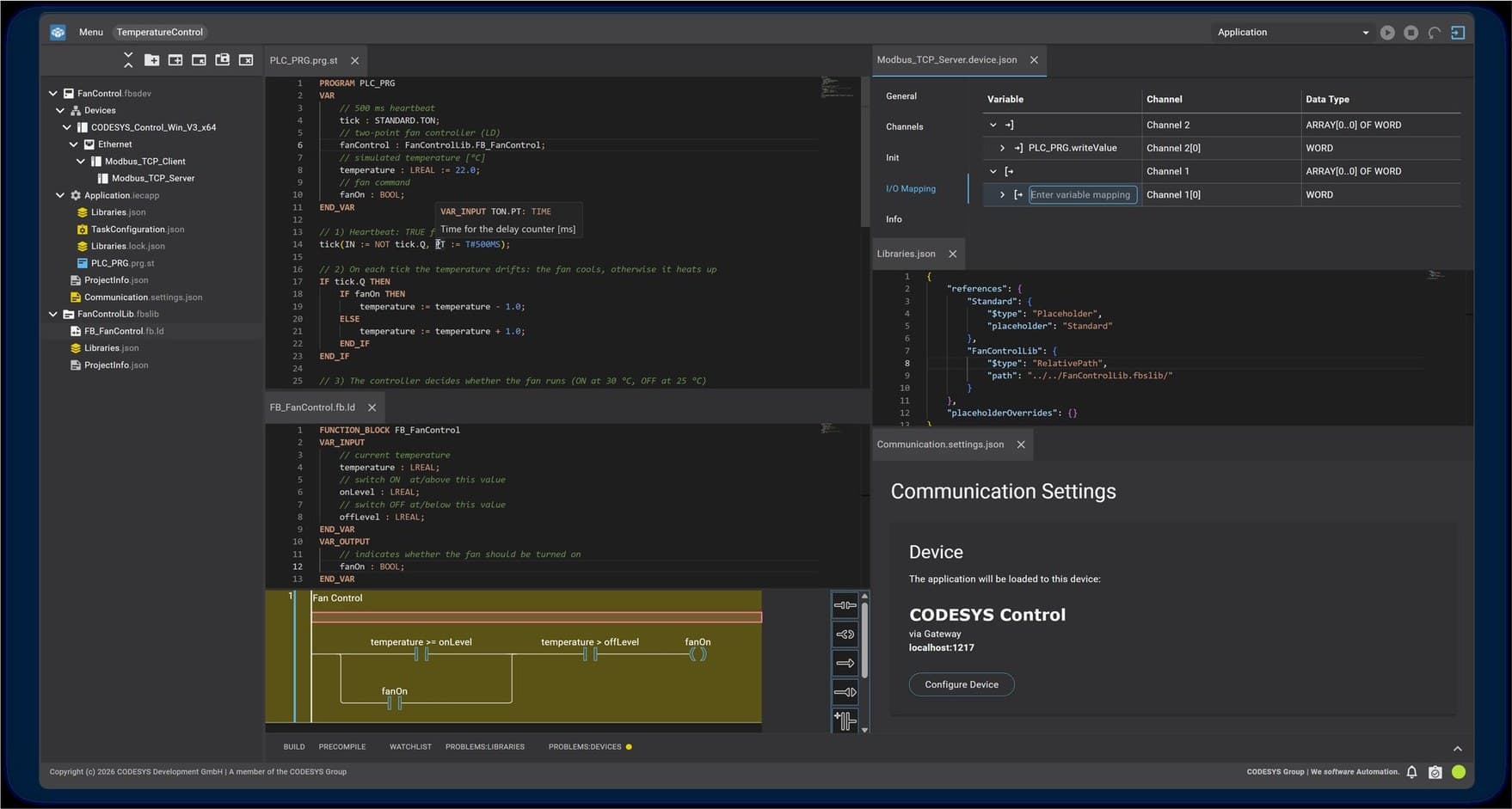
Put together, the theme is obvious: this is CODESYS built for a world where library code gets reviewed on a Git server and built by a pipeline, not just edited on one engineer's laptop.
Is it for you, right now?
CODESYS is upfront that v1.0.0.0 is deliberately narrow. It's a genuinely good fit for exactly three situations:
- You develop libraries in Structured Text. This is the headline use case — text-based storage, dependency files, and an automated build (
save-compiled) that produces a.compiled-libraryusable in both CODESYS 3 and 4. - You're building small machines or test benches on Modbus TCP. A manageable I/O count, Structured Text and Ladder logic, configured through the Modbus configurator.
- You already work on Linux or ARM hardware. The IDE itself runs natively there — no VM in the way.
Outside those three, CODESYS 3 stays your tool for now — and that's a fair trade, since it's free to use through the end of 2028 either way, so there's no cost to trying it on the side.
What's still missing
This is the section worth reading properly before you get excited and try to commission a machine with it on Monday morning. In v1.0.0.0, CODESYS 4 does not yet have:
- Online changes to a running program, breakpoints, or forcing/writing variables
- Live signal-flow display in Ladder at runtime
- Fieldbuses beyond Modbus TCP — EtherCAT included
- Visualization, Soft Motion, or safety
- Refactoring, cross-reference lists, project-wide undo/redo
- Test Manager, static analysis, automated module tests, library documentation generation
- Third-party editors and configurators from other vendors
For traditional commissioning at the machine — the stuff most of us do most days — CODESYS 3 is still the right tool. CODESYS says this plainly, and we'd say the same thing to a client asking us to do otherwise.
What's coming next
CODESYS spoke to Kevin Ketterle, who leads the development team, about where this goes from here. A few things worth knowing:
- EtherCAT is next in line for fieldbus support — the most-requested addition after Modbus, since it's the second most common bus in the CODESYS community.
- Visualization and Soft Motion are high priority for 2026 — HMI/panel configuration, and manufacturer-independent coordinated motion control.
- Releases target a 6–8 week cadence, shipped as full new versions (1.0 → 1.1 → 1.2) rather than service packs — fixes land with the next feature release, not as a hotfix.
- Development runs on Scrum, with priorities driven by an Early Adopter program and direct customer feedback rather than a fixed plan.
Ketterle's framing is worth repeating: the goal isn't to replace CODESYS 3, it's to tackle the industry's skilled-labour shortage by making library development — the part that actually scales across projects — fast, automated, and reviewable the way modern software already is.
Licensing and how to get it
- Free to use through the end of 2028. A paid model is planned for 2029 at the earliest, folded into the Professional Developer Edition.
- No extra cost if you're already on the Professional Developer Edition (CODESYS Git, CODESYS MCP Server, etc.) — CODESYS 4 is simply included.
- No pipeline license needed — the build machine running your CI/CD job doesn't need a separate seat in v1.0.0.0.
- Not a cloud service. "Web-based" describes the interface technology only — you install it on your own machine, your own server, or the controller itself. No internet connection is required to run it.
- Available now from the CODESYS Store — Windows x64 (.exe), Linux x64 and Linux ARM64 (.deb).
Our take
We use Codesys day to day, and this is a sensible first release rather than a flashy one — which, for a PLC development tool, is exactly what you want. Nobody needs their controller environment reinventing itself overnight.
If library work is part of what you do — building reusable function blocks, versioning them properly, having a build pipeline confirm they compile before anyone integrates them — it's worth setting up a lab project this quarter. It costs nothing, and the payoff (libraries you can genuinely track and review changes on) is real.
If your day is mostly commissioning machines on the floor — online changes, forcing I/O, watching signal flow live — there's nothing to do yet. CODESYS 3 remains the right tool, and will for a while. Worth knowing it exists, not worth switching for.
We'll keep this page updated as EtherCAT, visualization and Soft Motion land.

Comments
No comments yet. Be the first!